AuraQuote + BOM standardization
A PCBA quoting flow that standardizes messy customer BOMs, reviews material candidates, counts process work, and exports quote-ready Excel from one governed command pipeline.
The problem
Electronics quoting is not just uploading a spreadsheet. A customer BOM may omit MPNs, mix package notation, hide resistance and tolerance inside free text, and reference Gerber or coordinate files that arrive later. The team still needs line-level evidence, a reversible decision trail, and an export that explains missing prices or process points instead of silently inventing values.
How it's built on AuraBoot
- Modeled quote orders, source BOM rows, normalized material fields, candidate records, Excel versions, and review decisions as first-class AuraBoot models.
- Ran import, normalization, candidate scoring, confirmation, recalculation, and Excel generation through the command pipeline, so every state transition is validated, permissioned, and auditable.
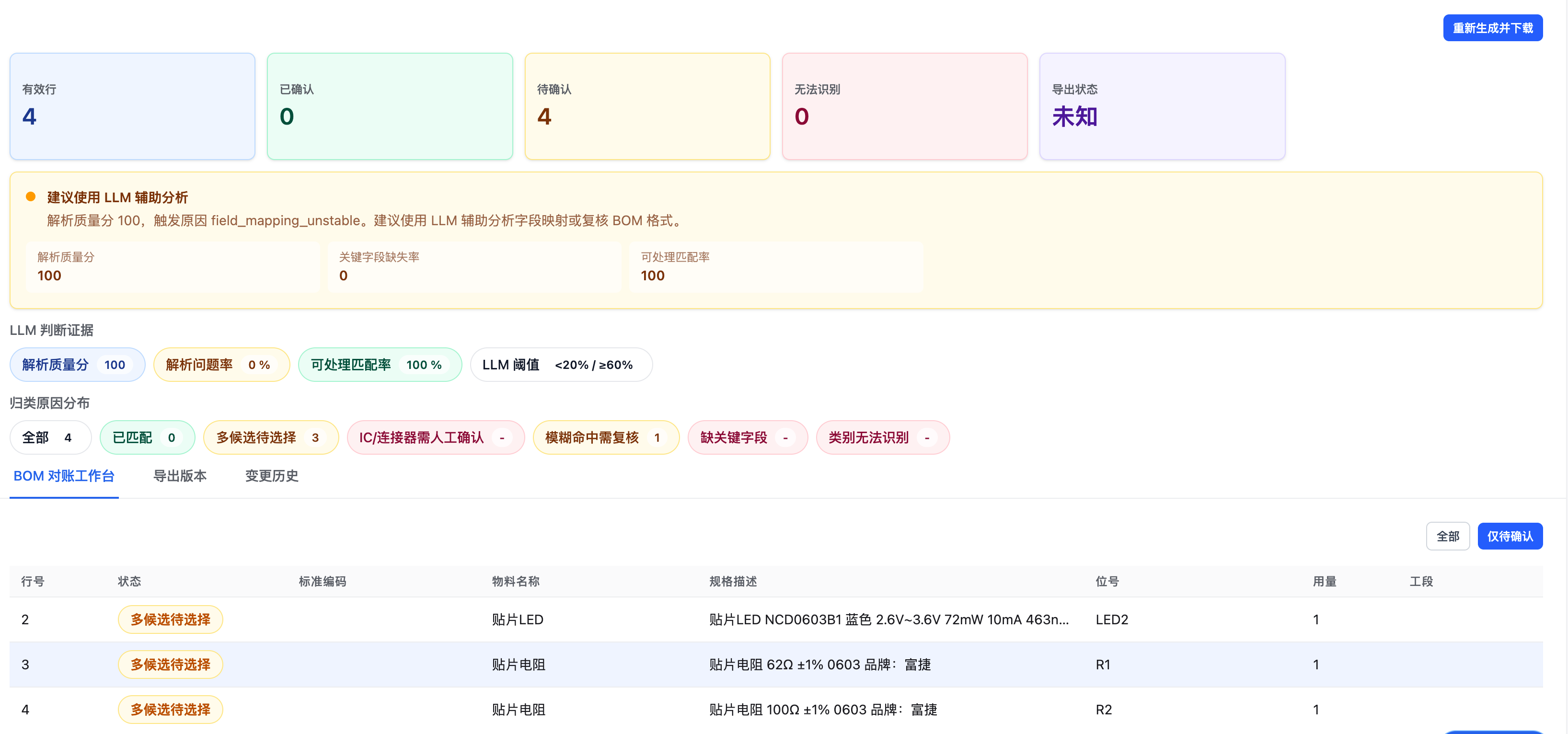
- Used workbench pages for the operator surface: metric cards, reason filters, evidence chips, row-level candidate review, version history, and download actions share the same platform renderer.
- Kept LLM assistance advisory: parse quality, reason taxonomy, and evidence summaries help reviewers focus, but write-back still requires an explicit command or human confirmation.
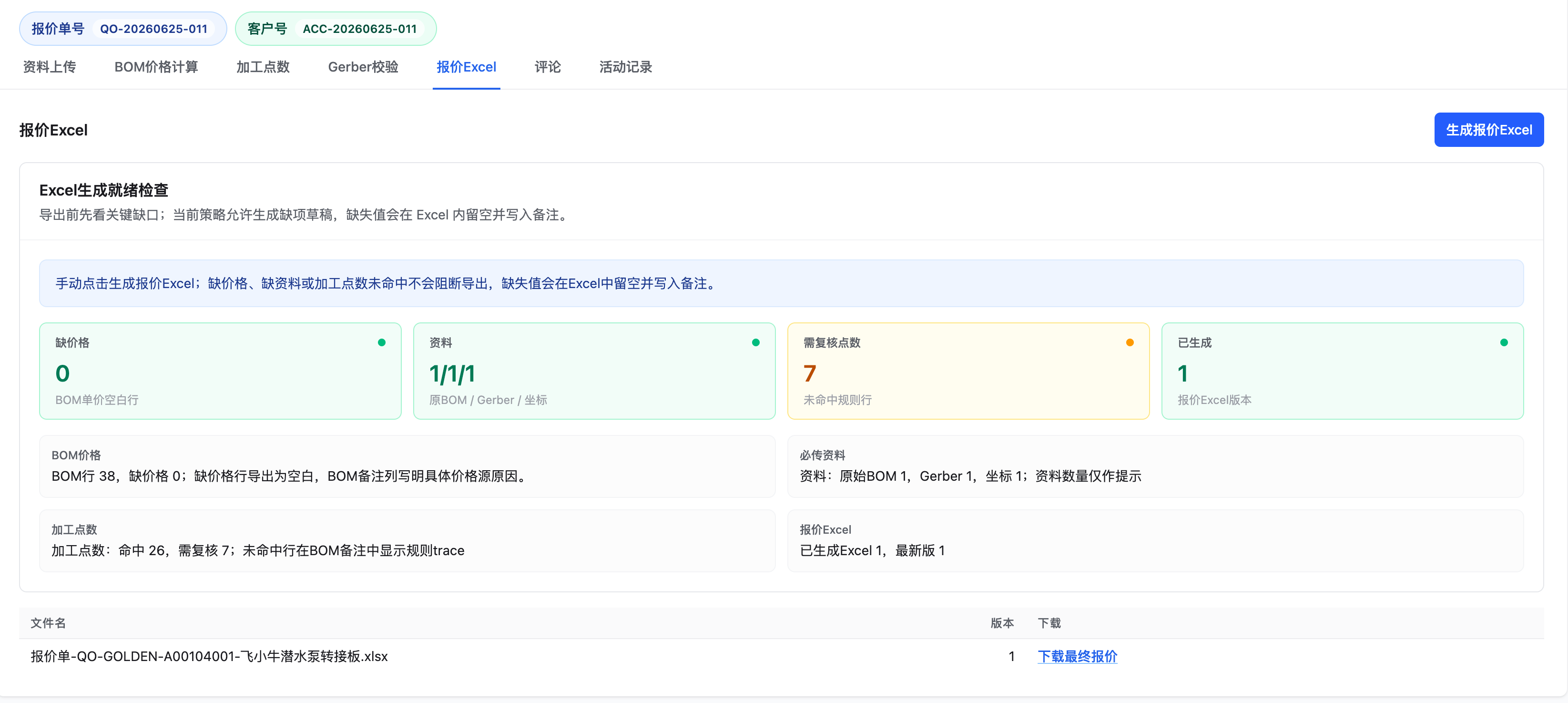
- Generated quote Excel only after readiness checks for material data, missing prices, process-point misses, and attachment completeness; gaps remain visible in the workbook instead of being hidden.
Built with
Model-first quoting data
AuraQuote treats quote records, BOM rows, candidate matches, export versions, and review decisions as governed platform records instead of temporary spreadsheet state.
- Dynamic model fields hold normalized package, resistance, tolerance, MPN, position, quantity, and reason codes.
- The same records drive list pages, detail pages, workbench blocks, commands, audit, and later exports.
- This keeps every reviewer action tied to a durable row instead of a copied worksheet cell.
Command-governed workflow
The key operations are commands, not ad-hoc button handlers: import BOM, normalize rows, calculate candidates, confirm a candidate, regenerate pricing, and export the quote workbook.
- Validation, permissions, idempotency, and audit sit on the same execution path.
- Risky operations can require explicit confirmation while read-only evidence remains freely inspectable.
- Versioned export commands make the generated Excel traceable and repeatable.
Workbench UX without one-off screens
The operator flow is assembled from platform patterns: metric strips, tabs, filters, evidence panels, drawers, row actions, and download controls.
- Status filters explain the queue: confirmed, multiple candidates, connector/manual review, fuzzy duplicate, missing keyword, or unrecognized category.
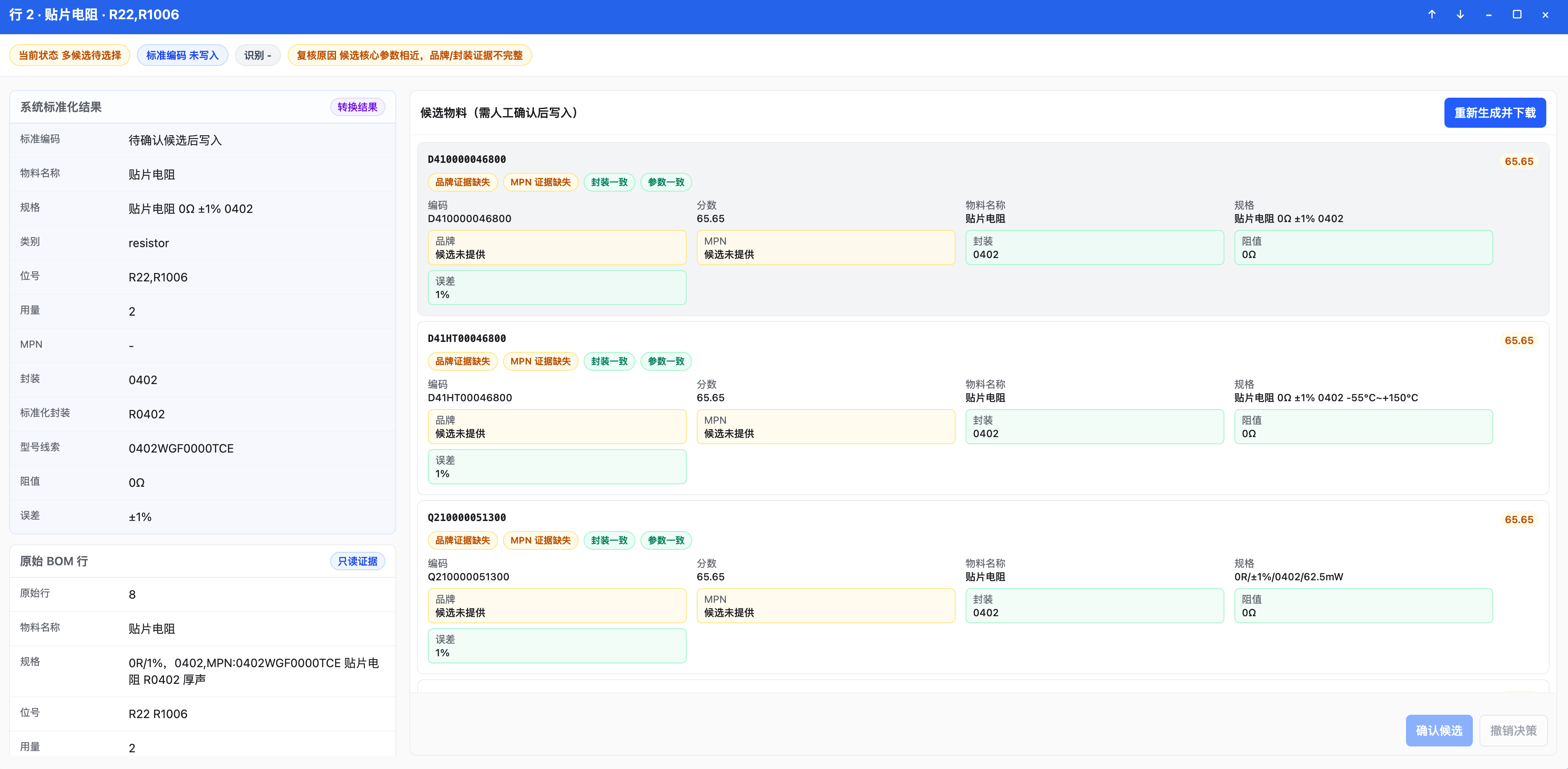
- The row drawer keeps parsed fields and original customer input side by side, which reduces blind confirmation.
- Operators stay in one product surface from upload to final Excel download.
LLM assistance with evidence boundaries
LLM help is used where it is useful and constrained where it is risky. It can summarize parse quality and reason distribution, but it does not silently change a material decision.
- Quality score, missing keyword rate, and matchable rate are visible before reviewers act.
- Evidence chips make missing MPN, brand evidence, package match, and parameter match explicit.
- Human confirmation remains the write boundary for ambiguous rows.
Export readiness and downstream trust
The quote Excel is not just a file download. The platform checks whether the data is ready and carries unresolved gaps into the workbook instead of pretending the quote is complete.
- Missing prices, attachment counts, process-point coverage, and generated versions are surfaced before export.
- The workbook can leave blanks with reasons, preserving the reviewer trail for downstream pricing.
- This turns Excel into a governed delivery artifact rather than a parallel shadow system.
Outcome
- BOM rows can be imported, classified, reviewed, confirmed, and exported without leaving the platform surface.
- Reviewers see why a row is matched, ambiguous, or blocked: missing MPN evidence, package mismatch, keyword extraction quality, and candidate score are displayed beside the decision.
- Excel output is governed by readiness checks and versioned downloads, so downstream pricing work receives a traceable file instead of an opaque export.
- The same pattern can be reused for other vertical workflows: DSL models for the data, commands for mutations, workbench pages for operators, and hybrid plugin handlers for domain logic.
Build something like this
Every product above runs on the platform you can self-host. Start with the docs.