Crawler data platform
A governed crawl operations product that turns jobs, frontier URLs, extracted documents, artifacts, lineage, quality checks, session / lease state, and usage cost / SLO signals into one auditable platform workflow.
The problem
A crawler is easy to demo and hard to operate. Once the workload grows, the team must answer operational questions that a script cannot answer: which URLs are waiting, which worker owns a lease, whether authorized session state is still valid, which document came from which request, whether extraction quality is good enough, how much the run costs, and what evidence downstream users can trust when a record is challenged.
How it's built on AuraBoot
- Modeled crawl jobs, seed batches, frontier URLs, fetch attempts, extracted documents, artifacts, lineage edges, session state, execution leases, usage events, and audit events as durable AuraBoot records.
- Routed create, start, pause, retry, cancel, requeue, QA review, and delivery handoff operations through commands so every mutation has validation, permission, idempotency, and audit semantics.
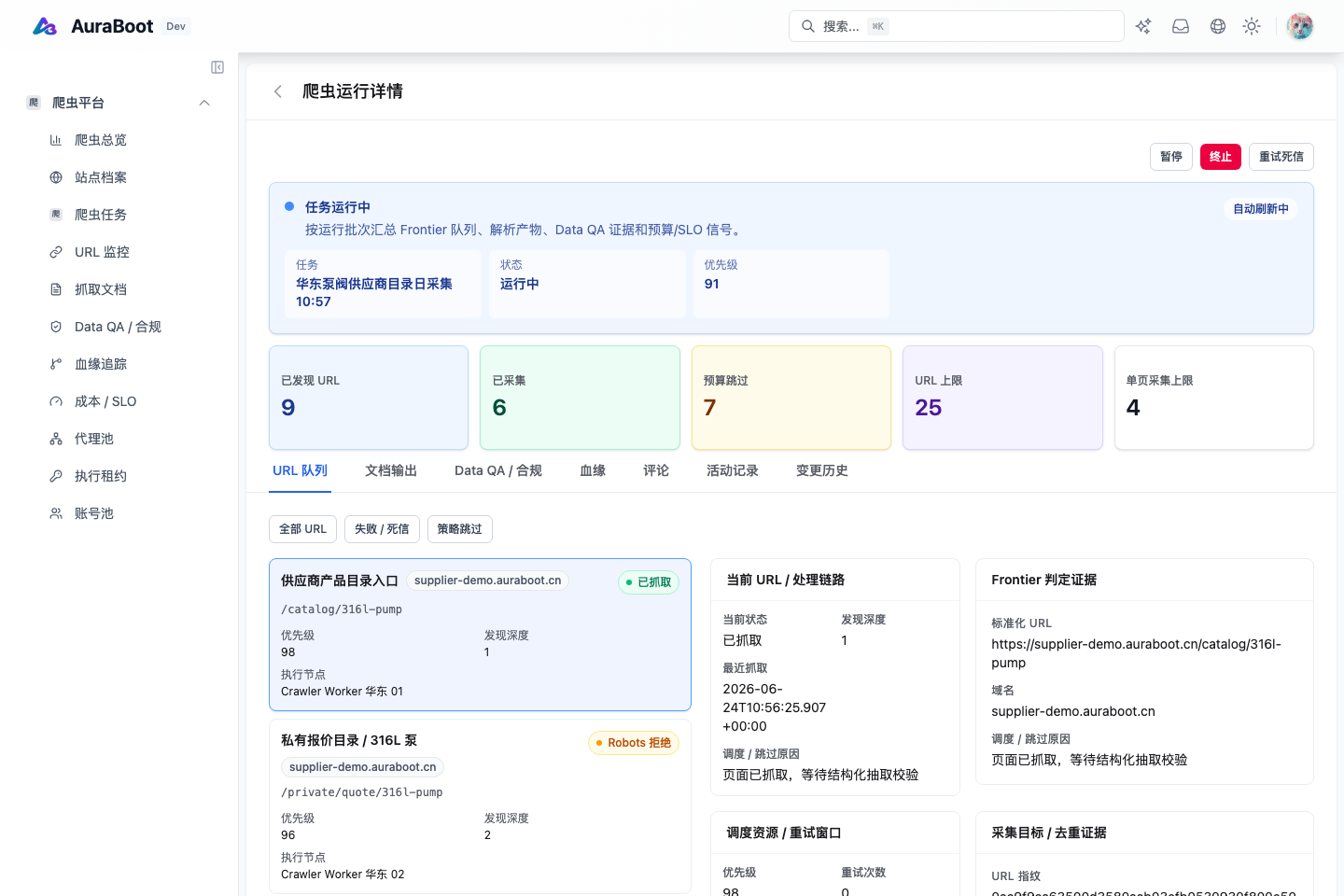
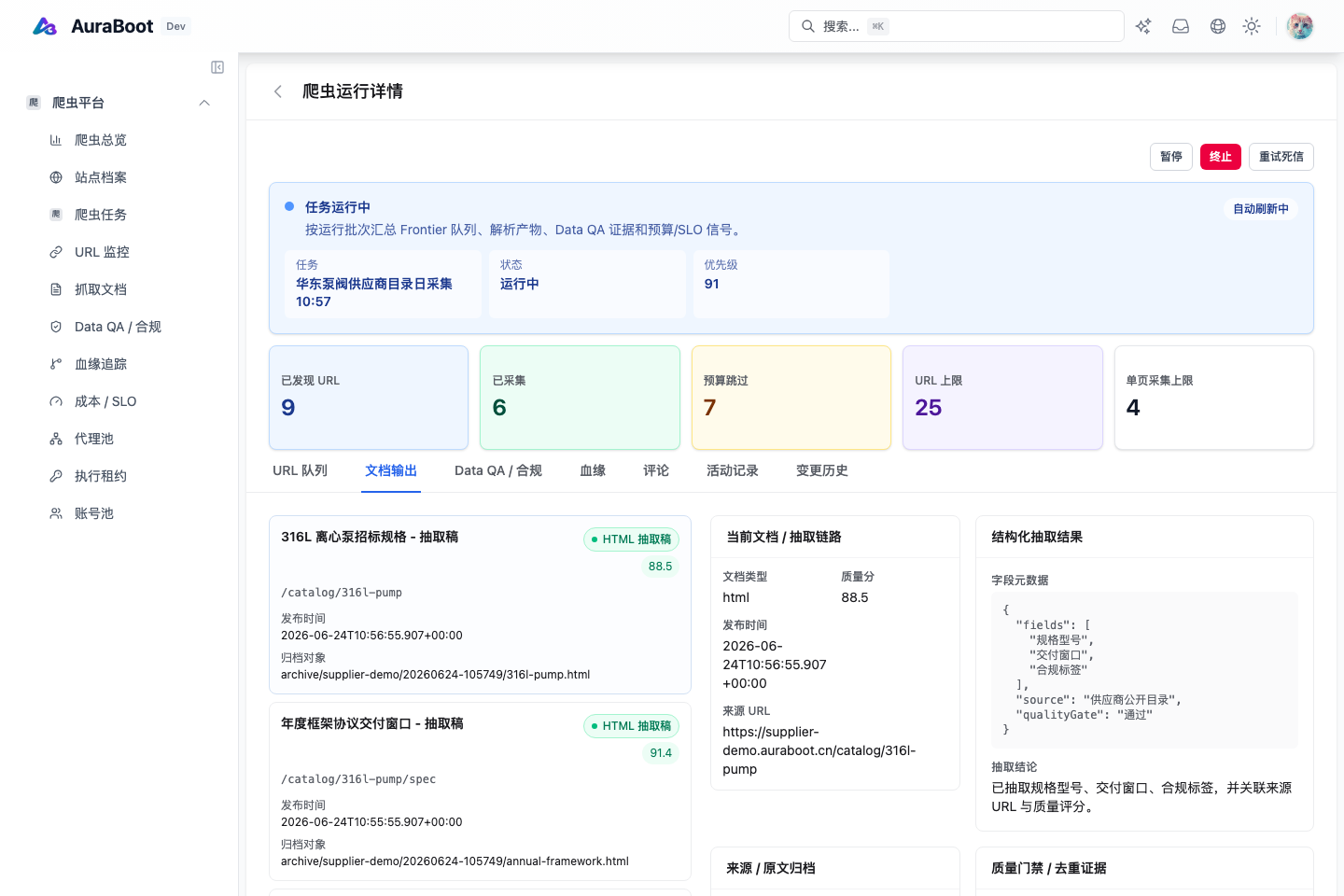
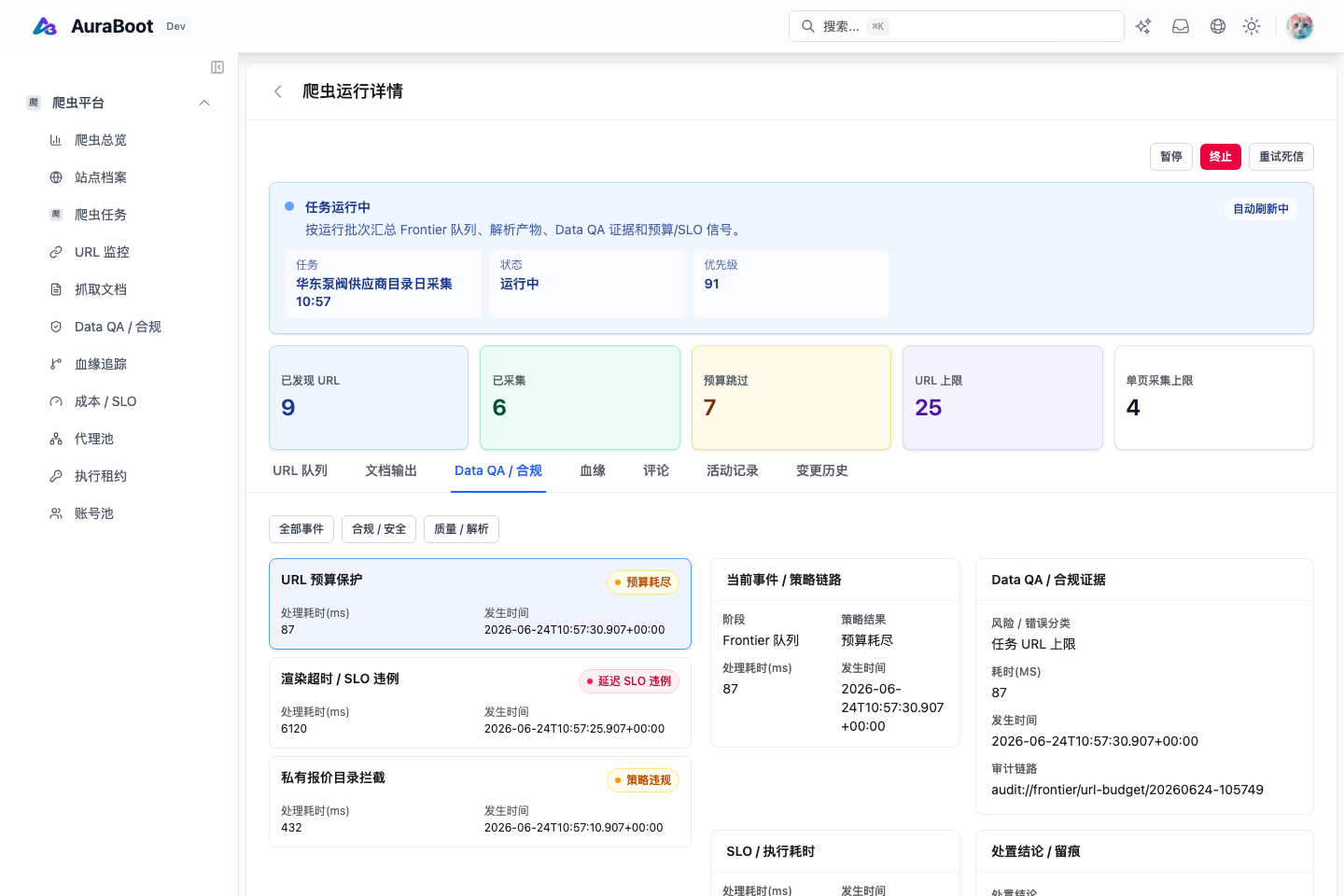
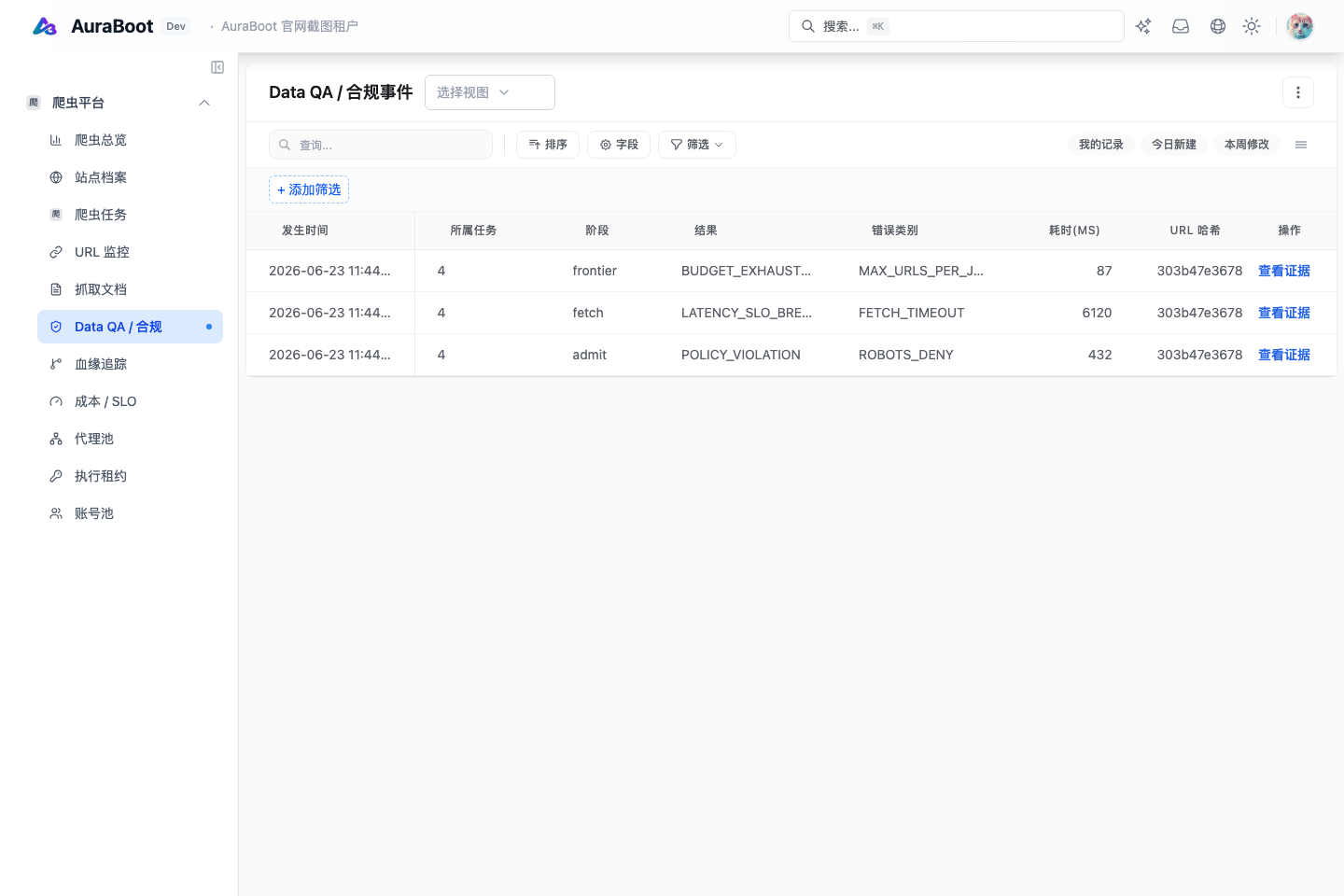
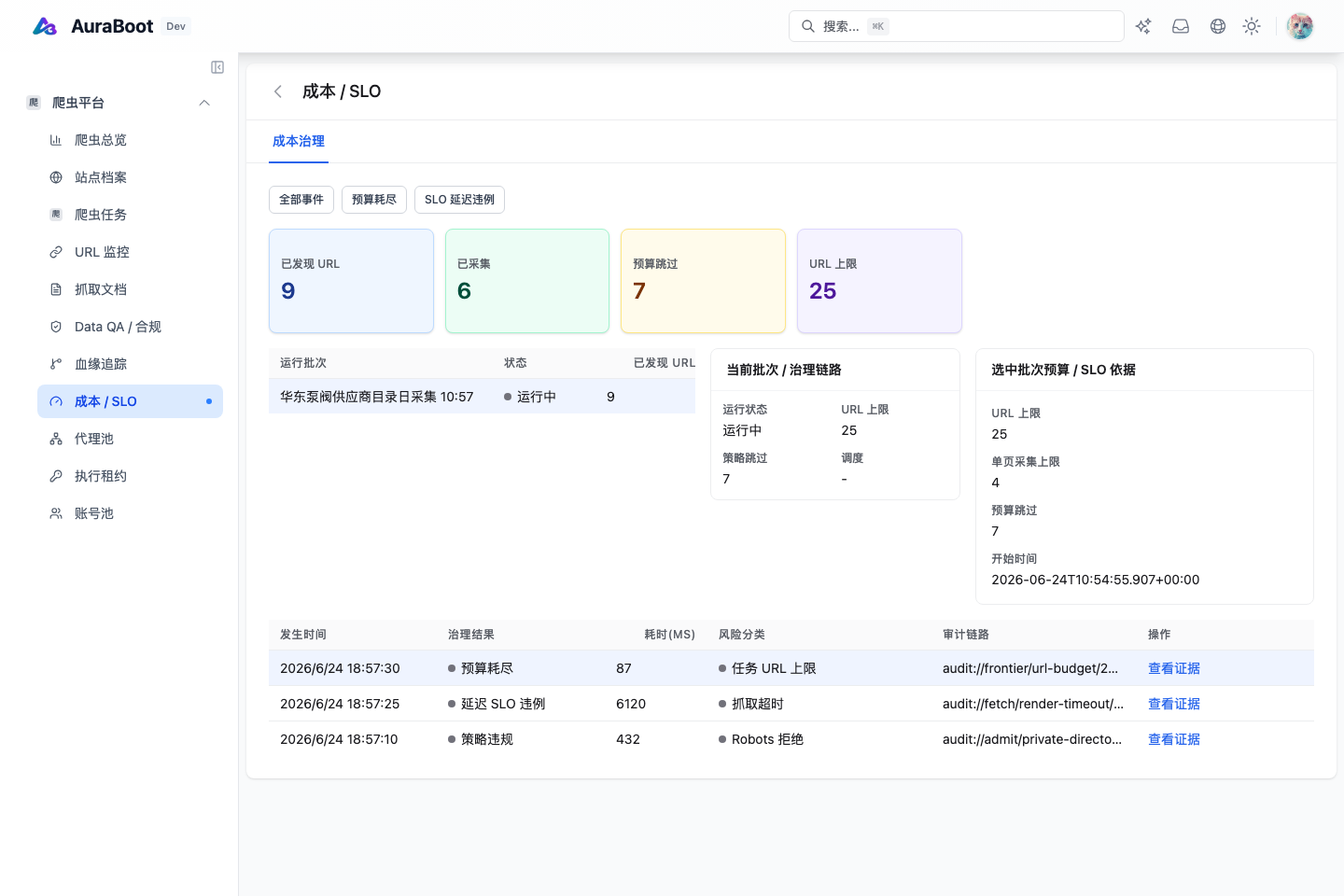
- Built operator workbenches for run detail, document output, lineage, Data QA, cost / SLO, session state, and execution leases instead of leaving operators to inspect worker logs.
- Separated worker execution from platform governance: crawlers can run as host-first services while the platform owns records, commands, artifact pointers, usage signals, audit, and integration handoff state.
- Recorded raw HTML, rendered evidence, extraction payloads, screenshots, and downloadable artifact pointers through the platform storage layer; event and search integration points stay explicit instead of being hidden in worker code.
Built with
Durable crawl domain model
The crawler is modeled as a product domain, not as a script folder. Jobs, seeds, frontier URLs, attempts, documents, artifacts, lineage edges, sessions, leases, QA findings, usage signals, and audit events are all durable records with stable identity.
- Operators can inspect the same job state from cards, tables, detail pages, and downstream QA views.
- Document records keep source, fetch metadata, extraction payload, artifact pointers, quality state, and delivery state together.
- The model gives retries and replay a stable target instead of relying on transient worker memory.
Command pipeline for crawler operations
Crawler operations are commands with contracts. The UI, worker adapters, and operational scripts call the same command semantics for job creation, start, pause, retry, cancel, requeue, QA review, and delivery handoff.
- Validation catches illegal state transitions before a worker receives work.
- Idempotency protects retries when network calls, browser fetches, or storage writes partially succeed.
- Audit events explain who changed a run, when it changed, and which command caused the change.
Evidence-first workbench UX
The operator UI is arranged around evidence. Run detail, document output, lineage, Data QA, cost / SLO, session state, and leases are separate views over the same governed records.
- Run pages answer what is happening now: frontier depth, processing state, worker ownership, and recent events.
- Document pages answer what was captured: raw source, normalized fields, storage artifacts, and extraction confidence.
- Lineage pages answer why a downstream record exists and which evidence supports it.
Data QA and lineage as product features
Quality is visible inside the crawler product. Field-level rules, extraction misses, duplicate signals, source freshness, and evidence links are presented before data reaches downstream systems.
- QA findings are records that can be filtered, reviewed, assigned, and resolved.
- Lineage links preserve source URL, attempt, artifact, parsed document, and downstream delivery relation.
- This gives data consumers a review trail instead of asking them to trust an opaque scraper output.
Cost, SLO, session, and lease governance
Crawler operations fail in operational ways: slow hosts, expired sessions, retry storms, stuck leases, large artifacts, and budget overruns. These signals are modeled and shown before they become incidents.
- Cost and SLO views track success rate, latency, retries, artifact volume, and budget pressure by run.
- Session and egress signals can be connected to failed attempts instead of treated as separate worker-only details.
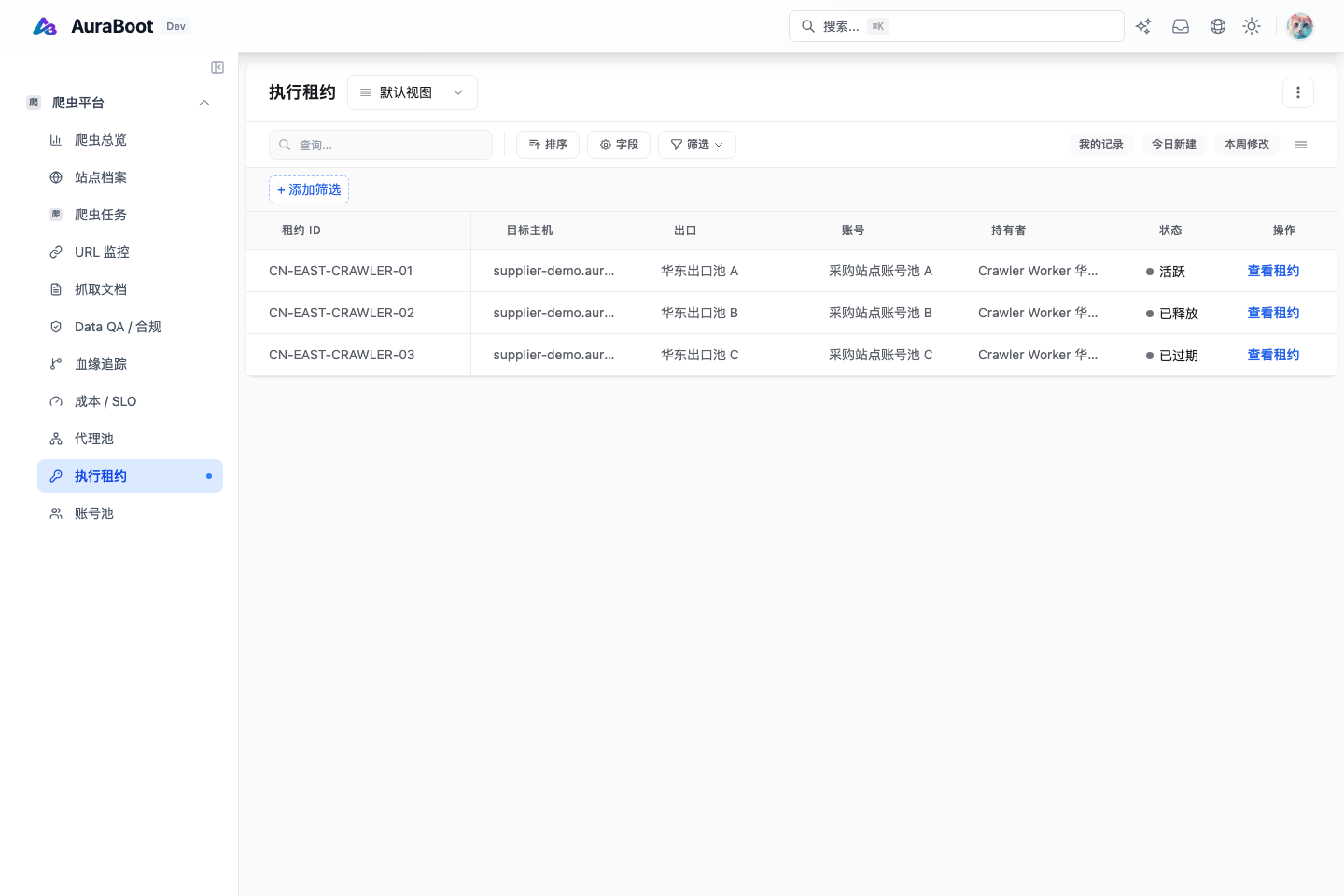
- Execution leases make worker ownership and stuck-task recovery explicit across a shared frontier.
Artifact and integration handoff without a shadow stack
Crawler-specific execution stays pluggable, while the platform owns the shared runtime concerns that should be visible to operators: artifact pointers, event handoff seams, search hooks, permissions, audit, usage signals, and delivery state.
- Object storage can hold raw HTML, screenshots, extraction payloads, and downloadable evidence artifacts with platform-visible pointers.
- Event integration points can carry lifecycle and extraction events for downstream processing or monitoring when a deployment enables them.
- Search integration can index document output so operators and downstream teams can find captured content quickly.
Clear delivery boundary
This case page shows the current delivery-ready operating surfaces. It should not be read as a promise of every future crawler roadmap item.
- Delivered surfaces include site profiles, job lifecycle, URL Frontier, document output, Data QA, lineage, session / lease governance, and usage cost / SLO workbenches.
- API/export consumption, event callbacks, and egress policies are project-scoped integration work rather than a blanket promise of a complete open SDK or billing platform.
- No-code crawler builder, RAG / vector Q&A, full vault lifecycle, browser context pool governance, and broad CRM / procurement / inventory / finance suites are intentionally not positioned as current Crawler case capabilities.
Outcome
- Operators can move from run status to URL frontier, document output, lineage evidence, QA findings, cost / SLO signals, and lease state without leaving the product surface.
- Downstream users get records with source URL, fetch attempt, extraction payload, artifact pointers, quality flags, and audit history, which makes disputed data traceable.
- Real-stack golden verification covers run detail, document output, Data QA, lineage, cost / SLO, session state, and execution leases across the self-hosted operator UI.
- The implementation pattern is reusable for any data acquisition workflow that needs durable jobs, evidence, quality gates, and governed delivery instead of one-off automation scripts.
Build something like this
Every product above runs on the platform you can self-host. Start with the docs.